
Styles and Prices

art style - vector drawing

I am primarily a digital artist specializing in vector illustrations of animals, plants, and occasionally landscapes. Throughout the years, I have cultivated a clean and straightforward style that effectively conveys my subjects. The level of detail in my work is guided by the intended purpose of each drawing. Even when depicting an idea with a single line, I consistently aim for accuracy and precision to ensure that my illustrations capture the essence of the natural world.

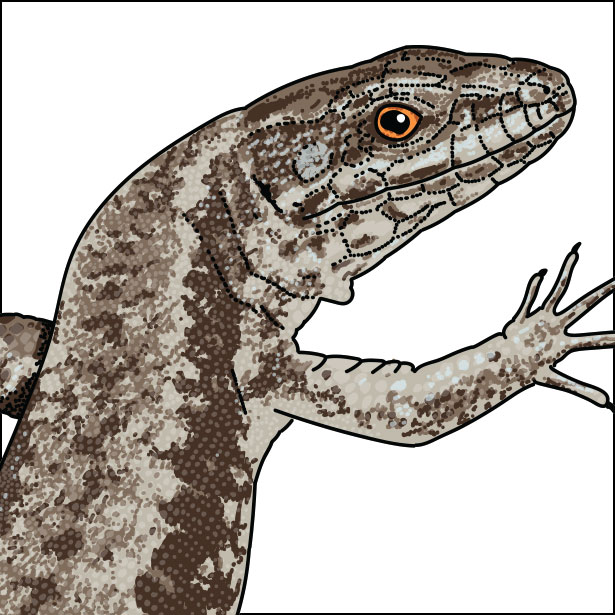
Detailled vector drawing illustration of a wall lizard by Paul Veenvliet

Detailed vector illustrations

Every illustration I create represents a simplification of reality, aimed at highlighting the most essential characteristics of an animal, plant, or landscape through dots and lines.

The degree of detail varies from piece to piece. More intricate details contribute to a more realistic appearance, but they also require significantly more effort to execute.

My reptile drawings exemplify the level of detail I most enjoy working with. Small dots can mimic individual scales, while the background is simplified into broader patches of uniform colours. A detailed illustration like this can take me anywhere from one day to several days to complete.

What are vector-images?

In simple terms, vector images are digital graphics that can be resized to any dimension without losing quality. Unlike “classical” images and photographs, which are raster images made up of pixels, vector images maintain clarity and sharpness no matter how much they are enlarged.

Vector images represent colors as points, lines, and polygons of various dimensions and shapes. While it’s straightforward to convert vector images into raster formats, the reverse process is more complex and usually requires tracing the raster images in illustration software.

Vector images are often favoured for printed materials due to their scalability and detail. However, not all software can open them. For example, to display my vector illustrations on this website, I had to convert them into raster images, as your browser would not be able to render them otherwise!

Comparison betwene a raster photograph and a vector illustration of a butterfly.
Two simplified vector drawings of pinecones.

Simple vector illustrations

In practice, this is the drawing style I use most frequently. I create simplified vector images that accurately represent the colors of plants and animals while omitting most details.

This approach strikes a balance between speed and precision. Depending on the subject and the extent of research I conduct for reference, I can produce several of these drawings in a single day.

To ensure accuracy, I primarily base my illustrations on photographs I take specifically for my work. This practice allows me to capture the essence of my subjects while maintaining the simplicity and clarity that define this style.

Vector illustrations of two sturgeon species, meant for an identification key.

Illustrating identification keys

Identification keys are designed to assist in the identification of animal and plant species. Typically, these keys consist of a series of questions, each offering two or more possible answers. They often require close examination of specific anatomical features, which are usually described using technical terminology. The purpose of my illustrations is to provide clarity on what to observe.

For these illustrations, I focus on including only the essential details while keeping the overall representation as consistent as possible. However, accuracy remains crucial, and many of my drawings are rendered in black-and-white to minimize distractions from the characteristics described in the accompanying text.

Although creating these drawings takes a relatively short amount of time, I often invest considerable effort in research to ensure accuracy. It is also common for me to revise the same drawing multiple times based on feedback from specialists in the field.

Detailed black and white drawing of a Marsh frog, Pelophylax ridibundus.

Black-and-white drawings

I spent countless evenings creating these illustrations using a black fineliner on paper. In fact, it was this black-and-white “stippling” technique that initially sparked my passion for illustrating.

For these drawings, I primarily relied on my own color slides as reference material. I even developed a unique method to project the slides downward onto the drawing paper. However, tilting an old slide projector posed a challenge, as it obstructed ventilation, causing the light bulb to overheat and eventually burn out!

I mention this in the past tense because, nowadays, I create these drawings digitally. The results remain strikingly similar, with the added advantage of being resizable.

Completing such a drawing typically takes me anywhere from four hours to several days, depending on the complexity of the subject.

Cartoons

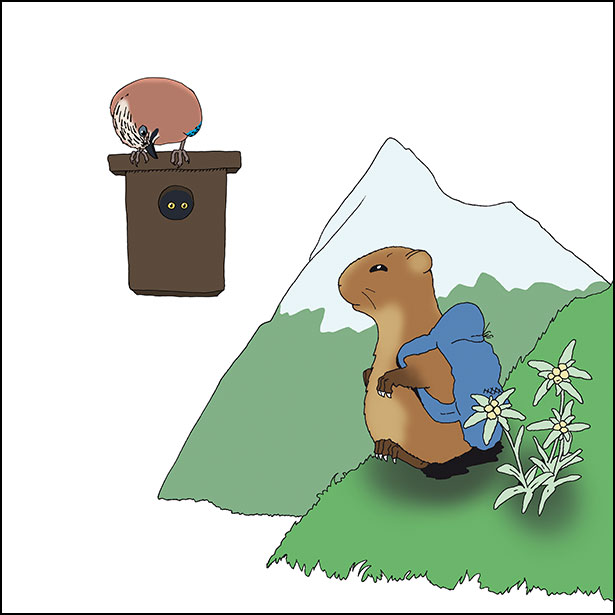
From time to time, I create humorous drawings that add a playful touch to poster exhibitions and educational displays. Like my other illustrations, these cartoons are inspired by nature, but they allow for more creativity and less emphasis on accuracy. I often find myself smiling at my cartoonish creations, and I hope you enjoy them as much as I do!

Cartoon illustrations by Paul Veenvliet
Dog portraits in black and white

The price of an illustration

The price of my illustrations typically ranges from 25 to 250 Euros, depending on factors such as complexity, style, licensing conditions, and the time spent on research. For larger series of drawings, I can offer discounts. It’s always helpful to share your budget when we discuss your project, as it allows me to tailor my offerings to meet your needs.

The pricing for my illustrations is generally based on a specified use (such as for publication in a book) and includes:

  • My working time
  • The software and hardware used to create the drawing
  • Travel expenses for capturing reference photographs (including time spent searching for specific animal and plant species)
  • VAT