
What is happening to our world? Some environmental impacts, such as climate change, can seem so vast and abstract that it’s often challenging to understand what we, as individuals, can do to make a difference.
However, we influence our environment in many other ways—often at a local level—which may be more preventable if we were more aware of our actions. Through these drawings, I aim to illustrate how we impact our immediate surroundings.
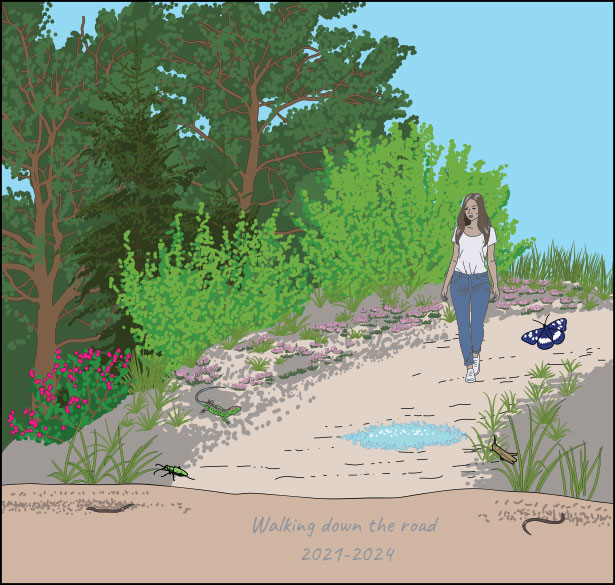
Many years ago, I taught ecology as part of a B. Sc. education on Wildlife Management. During my lessons, I would often create large drawings on the blackboard to illustrate various human impacts, and my students loved it!
In this spirit, I have developed a few of these “ecological explanations” into colorful before-and-after drawings to convey the concepts more vividly.
Plants do not always stay where they are planted. In fact, many species have developed ingenious ways to relocate to new areas. The Japanese barberry (Berberis thunbergii) relies on birds for this purpose. This plant encases its seeds in a nutritious layer known as a berry, which serves as bird food. Birds consume these berries along with the seeds and then spread the seeds through their droppings. As a result, the Japanese barberry, which is a very common garden plant, is increasingly found in the wild across Europe.
I created these drawings for an information plate developed as part of Project LIFE ARTEMIS. This plate is installed in Landscape Park Tivoli, Rožnik, and Šiška Hill in Slovenia, at a location where we removed invasive Japanese barberry bushes during the project.


Can you spot the difference between a natural and a managed forest? The presence of dead trees in a natural forest is the most obvious distinction, but there are many other, more subtle differences as well.
Through these drawings, I aim to illustrate not only the contrasts within the forest itself but also the differing human attitudes toward these environments. In a natural forest, we are simply visitors, whereas in a managed forest, we might encounter a hunter—someone who can have a significant impact on the surrounding ecosystem.
I created these drawings to illustrate how hydropower plants alter rivers and the subsequent effects on the ecosystem and human activities. In short, dams slow down the current and disrupt both fish migration and the natural flow of sediments. Over time, underwater plants are largely replaced by algae, rivers become deeper, and even groundwater levels are affected. Additionally, the decomposition of organic sediment in hydropower lakes releases greenhouse gases.
While hydropower lakes are sometimes promoted as tourist destinations, the reality includes fluctuating water levels, algae blooms, and unpredictable currents, often resulting in restricted access for visitors.
I initially created these drawings because I believe it’s important to share the complete story, rather than solely the narratives presented by energy companies. Subsequently, some of the illustrations were used in an educational campaign by project Za Savo.


In these illustrations, I represent the effect of fertilizer using red circles marked with the letter “N” (for Nitrate). In areas with little or no fertilizer, you find a highly diverse grassland community teeming with specialized plants and animals. However, this diversity begins to diminish when fertilizer is introduced, as the fastest-growing grasses outcompete other plant species. Consequently, a fertilized meadow loses its ability to support a wide variety of animal life.

The illustration featuring the cow highlights the origin of excess fertilizer. European cows are primarily fed with plant-based food sourced from South America, represented by green shapes resembling the continent. While milk is exported from Europe, the cow manure—rich with South American nutrients—remains in Europe, contributing to the nutrient imbalance.
When common carp are introduced into a pond, they initiate a chain reaction that transforms the entire underwater environment. By feeding on plants and stirring up sediment, they create conditions that are ideal for algae growth, causing the water to become turbid and green. The release of nutrients from the sediment and from the digested plants (in fish feces), is referred to as “internal eutrophication.”
These drawings are used by the municipality of De Bilt (NL) to illustrate the reasons behind their decision to remove carp from local water bodies.

